

Read the companion piece: Can't Believe Anything You See? Here's What Still Works.
Sunday night the New York Times re-shared a piece on Facebook with a picture of a FedEx Office employee lifting a boxed LG television. At phone size I couldn't find anything wrong with it. That was the point. Google's Gemini made the image, and the Times piece by Stuart A. Thompson, built on work by researcher Henk van Ess, walks through how the giveaways people relied on are mostly gone. The hands have creases and veins. The text reads fine at a glance.
The Times still found mistakes if you zoom in. The grout lines in the tile floor wander off in different directions instead of forming a grid. LG's slogan, Life's Good, comes out as "Lifea Cord." The lanyard isn't actually attached to the badge. Readers later noticed that the man in the badge photo doesn't match the man holding the box.
Those are good catches. They also took a newsroom, an outside researcher and a lot of zooming, and the Times itself hedged with "at least for now." I'm not betting my eyes against the next model.
So I asked the question an analyst asks first. Never mind what the picture shows. What does the file say about itself?
There's more in the file than the picture
A current AI image can carry three kinds of evidence, and only one of them is meant for people.

The visible mark. Gemini puts a small four-point sparkle in the corner. You can crop it off in two seconds, and since Aug. 14, 2026, Google has let users switch it off in settings. It's a courtesy, not a security feature.
Content Credentials. This is a signed record tucked inside the file, built on an open standard called C2PA. Think of it as a receipt from the tool that made the image. When I opened my test image in a checker, the record said it was signed by Google Media Processing Services, listed the source as trainedAlgorithmicMedia (the industry's term for "a generative AI made this") and noted "Applied imperceptible SynthID watermark." The checker ran 11 validation tests on the signature, and all 11 passed.
The hidden watermark. SynthID is Google's invisible pattern woven into the pixels themselves. You can't see it, and you won't find it by reading the file's code. You need Google's detector, which also reads the same watermark from OpenAI, NVIDIA and Kakao tools.
That answers the question that started this. Is there anything in the actual hex that gives a fake away? Yes, when you have the original. In a JPEG the Content Credentials sit in a block that starts with the bytes FF EB, and plain words like c2pa show up inside it if you go looking. In a PNG they live in a chunk labeled caBX. The catch is the phrase "when you have the original." Almost nobody does.
I made a fake fender bender
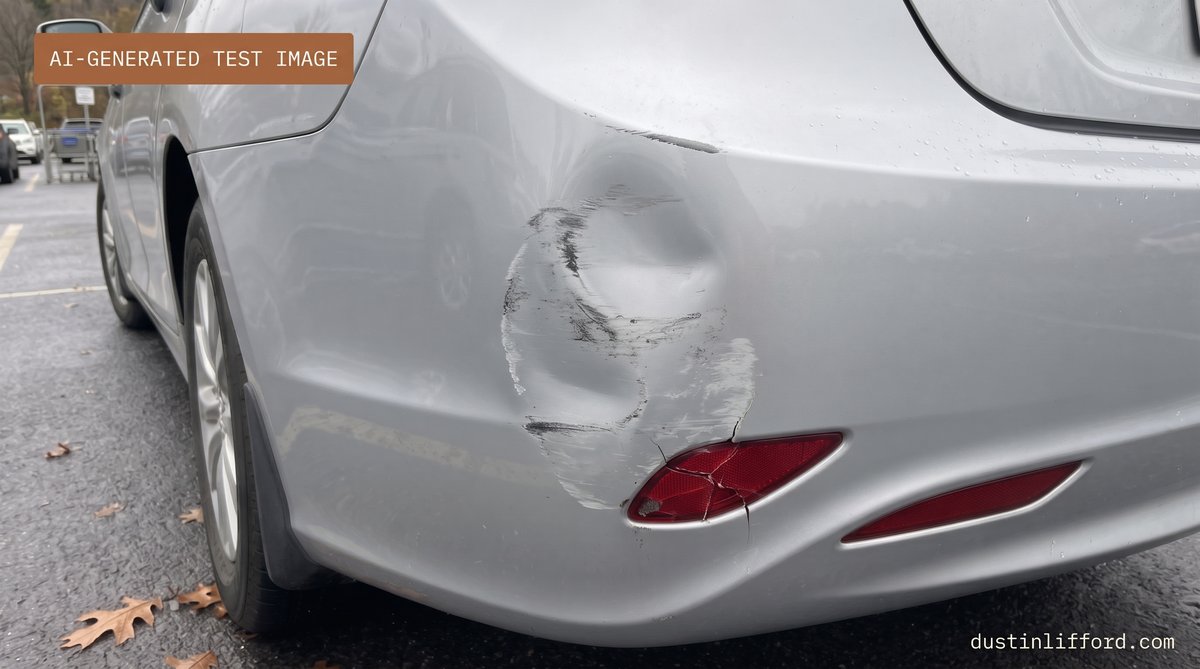
To see what survives normal sharing, I had Gemini make a phone-style photo of a dented silver sedan in a grocery store parking lot. Wet asphalt, oak leaves, a cracked reflector. The kind of picture that goes with an insurance claim. The car is fine. There is no car.
Then I ran the same checks on four versions of it. One was the original download, one was the copy I saved back off Facebook after posting it to myself only, one was a screenshot of that Facebook post, and one was a tight crop of the screenshot that cut the sparkle out of the corner.
Facebook did one thing I didn't expect. Its post composer had an AI label setting, and it was set to off. I left it off. The post went up labeled "AI content" anyway. Facebook read the Content Credentials when I uploaded the image, used them to label the post, and then handed back a download with the credentials gone. The checker found nothing in that JPEG. So the label stays on Facebook, and so does the evidence. Anyone who saves the picture and posts it somewhere else starts with a clean file.
Facebook does deserve credit for catching mine. It doesn't always. When the newsletter Indicator posted 105 AI images to Instagram in March, 15 got a label.
The hidden watermark held up through every step, including the crop that removed the only mark a person could see. Google's detector still said the image was made or edited with Google AI.
"Nothing found" doesn't mean "real"
This is where people get hurt. Every checker here can say yes. None of them can say no.
Google's own help page for its Gemini checker says a "not detected" result means Google's AI didn't make it, and that some other AI system still could have. Open-source image models, the kind anyone can run on a home computer, add no watermark and no credentials at all. And as my Facebook test showed, the credentials from tools that do add them rarely survive a trip through social media.
The detectors that guess from the pixels aren't a safety net either. A research team that tested commercial detectors on 1,975 images that had actually circulated online found the best one was right 82 percent of the time, and it missed about 3 in 10 fakes. None of the commercial tools they tested reached 90 percent. It cuts the other way too. In May, NewsGuard ran 15 genuine war photos through five popular detectors. One called 6 of them AI. Two others got all 15 right.
Watermarks have edges as well. When an AI picture of Venezuela's Nicolás Maduro supposedly in U.S. custody spread in January, Full Fact found SynthID in some copies. Other copies that had been cropped, filtered or screenshotted weren't flagged.
And a valid stamp isn't a verdict
The signed credentials are the strongest thing in the file. They have still been fooled.
In September 2025, a Nikon shooter who goes by Horshack got a Nikon Z6 III to put its authenticity signature on a Gemini-made picture of a pug flying a jet. Nikon suspended the feature and revoked every certificate it had issued. In August of this year, researcher David Buchanan showed he could make a hacked Pixel phone sign an AI image as an unedited photo straight from the camera app. And an April paper by researchers from UMBC, the image forensics firm Hacker Factor and the NSA concluded the standard doesn't yet meet its own security goals. In one test they changed the GPS location on a Pixel 10 Pro photo, and a verification tool didn't notice.
Sometimes the file testifies for the other side. In Mendones v. Cushman & Wakefield, a California judge threw out a lawsuit in September 2025 after finding that video and photo exhibits were AI-generated. One video's metadata said it was shot on an iPhone 6 Plus running iOS 12.5.5. The plaintiffs' own explanation needed Apple Intelligence, which requires iOS 18 and an iPhone 15 Pro or newer. The pixels looked like a witness. The file said otherwise.
One more wrinkle. A watermark hit no longer tells you whose tool made the picture. When a fake image of an elderly couple supposedly robbed during October's unrest in Paris spread, Lead Stories found SynthID in it, and OpenAI's own checker identified it as an OpenAI image. Google's watermark, OpenAI's picture.
The rule I take from all of it is that metadata proves presence, never absence. A signed record that says "AI made this" is worth a lot. A missing record mostly tells you the file has been places.
What I'd do with a photo that matters
For a picture you're about to share, report or pay a claim on, I'd work through these in order.
- Ask for the original file. Not a screenshot, not a Facebook link. Email attachments, and the "send as file" or document option in messaging apps, tend to keep more of the file intact than a normal photo send.
- Check for the hidden watermark. Upload it to Google's SynthID Detector. A hit is strong evidence. No hit only means the four companies it covers weren't involved.
- Check for Content Credentials. If they're present and valid, you'll see what made the file and what's been done to it since. If they're missing, that's normal and tells you very little.
- Look the way the Times did. Trace lines that should run straight. Zoom in on small print. Check whether things that should connect actually do.
- Search for earlier copies. A reverse image search often turns up the first post, and sometimes the first poster said outright that AI made it.
- Treat "nothing found" as nothing found.
| Tool | What it checks | Worth knowing |
|---|---|---|
| Google SynthID Detector (synthid.com) | Hidden watermark from Google, OpenAI, NVIDIA and Kakao tools | Free with sign-in. Opened to everyone Oct. 7, 2026. |
| Gemini (app or gemini.google.com) | Google's watermark plus Content Credentials | About 10 image checks a day. Only recognizes Google's own watermark. The credentials check isn't in the iPhone app yet, so use the website. |
| Content Credentials inspector (contentcredentials.org/verify) | Content Credentials and edit history | Shows who signed the file and each recorded step since. |
| C2PA Viewer (c2paviewer.com) | Content Credentials and signature checks | Independent tool. Reads the file in your browser without uploading it. |
| OpenAI's Verify tool | OpenAI's watermark and credentials | Only for images made with OpenAI tools. |
| Reverse image search (Google Lens, TinEye) | Earlier copies of the picture online | Finds where it came from, not whether it's true. |
The Times ended its piece by saying a trained eye can still catch some errors, at least for now. I believe that, and I'd still rather not depend on it. The habit that ages better is a boring one. Before arguing about what a picture shows, find out where the file came from, and ask for that file.
Sources
- "This Photo Is an A.I. Fake. Can You Tell?", Stuart A. Thompson, The New York Times, Oct. 8, 2026
- Gemini Apps Help, verifying AI-generated content, Google, accessed Nov. 4, 2026
- SynthID Detector opens to everyone, Google, Oct. 7, 2026
- Google lets users turn off Gemini's visible watermark, ProPakistani, Aug. 15, 2026
- "AI labeling is still very much a work in progress", Alexios Mantzarlis, Indicator, March 18, 2026
- Deepfake-Eval-2024, arXiv, version of May 27, 2026
- AI image detectors and authentic war photos, NewsGuard, May 8, 2026
- Maduro custody image fact check, Full Fact, Jan. 7, 2026
- Nikon revokes all C2PA certificates, Digital Camera World, September 2025
- Android C2PA forgery, David Buchanan, Aug. 25, 2026
- "Verifying Provenance of Digital Media: Why the C2PA Specifications Fall Short", arXiv, April 2026
- Mendones v. Cushman & Wakefield, eDiscovery Today, Sept. 25, 2025
- Fake image of elderly French couple, Lead Stories, Oct. 19, 2026
- C2PA Technical Specification, Coalition for Content Provenance and Authenticity