

Read the companion piece: Don't Trust the Photo. Ask for the File.
A few days ago at CVS, a woman said she was tired of computers, and she sounded scared of them. This week I was standing in line to vote, and two women in line were talking about AI. One of them said you can't believe anything you see anymore.
Two places, one week, same worry. I don't think either of them is confused. They've noticed something real, and nobody has handed them anything to do about it. This is my try at that.
You're not imagining it
Pew Research Center asked Americans last year how confident they were that they could tell whether pictures, video and text were made by AI or by people. Fifty-three percent said they weren't too confident or weren't confident at all. In the same survey, 76% said being able to tell is extremely or very important.
Most people care a lot about this and don't feel up to it. That's a reasonable place to be, because the eye test really has gotten hard. Researchers at Northwestern ran more than 50,000 people through real and AI-made pictures. People got the AI images right about three times out of four. Simple portraits fooled them most, and a one-second glance did worse than a ten-second look. Some people got only about a third right. That was in a study where everyone knew they were being tested. Scrolling Facebook after supper is not a lab.
So if you can't tell by looking, you're normal. The good news is that looking was never the best tool anyway.

Two ways a photo can fool you
The first way is the one everybody worries about, a fake passed off as real. During Hurricane Helene in 2024, a picture of a flooded mountain street with cars under water went around Facebook captioned "Gatlinburg, Tennessee today." The City of Gatlinburg posted that it was an AI photo and "NOT Gatlinburg." The town never flooded. That fake ran while a lot of people in our part of the world were looking hard for real news about Helene.
The second way gets talked about less. It's something real getting called fake. On Nov. 1 of this year, a small jet went down onto a road in Palm Beach County, Florida, and everyone on board was killed. A driver's dashcam caught the crash. Posts on X called the video "100% AI" and shared screenshots of an AI detector as proof. PolitiFact traced it to the man who filmed it. The Associated Press, CNN, CBS and the BBC had all carried it, and when PolitiFact ran the original through the same detector, it didn't flag it. A Clemson researcher told PolitiFact this is what happens when people get "so accustomed to being lied to" that they miss the truth when it's right in front of them. Researchers have a name for it, the liar's dividend. Once everyone knows fakes exist, "that's AI" becomes an easy way to brush off something real.
Both problems are real, and they have the same fix. Neither one was settled by somebody staring harder at the picture.
Why "trust nothing" is the wrong lesson
When something feels this slippery, the natural reaction is to doubt everything. Researchers have tested that, and it backfires. A 2024 study ran more than 6,000 people in the United States, Poland and Hong Kong through the usual warnings, fact-checks and media literacy tips. People got better at rejecting false claims, and they also started doubting true ones. The lead researcher, Emma Hoes of the University of Zurich, pointed out that reliable, fact-based news is still far more common than misinformation.
Doubting everything also lands you in the same spot as the people yelling "that's AI" at a real crash video. The goal isn't to trust nothing. It's to check the few things that matter before you act on them or pass them along.
What still works
The people who settle these cases don't win staring contests with pictures. They find out where the picture came from.
WCYB in Bristol showed how that works this summer. Viewers send in storm photos, and the station's meteorologists check each one against National Weather Service information and other reports from the same area before it goes on the air. As News 5 meteorologist Teresa Carter put it, "A lot of things on social media aren't real." Snopes did the same thing in August with security camera footage of a deadly flood at the Nepal and China border. People under a post seen more than 13 million times said it was AI. Snopes found the Nepali newspaper that posted it first, matched the border gate in the video to a photo of the same gate from April, and pointed to aerial footage after the flood showing the gate was gone. It was real.
You can do a home version of that in a couple of minutes.
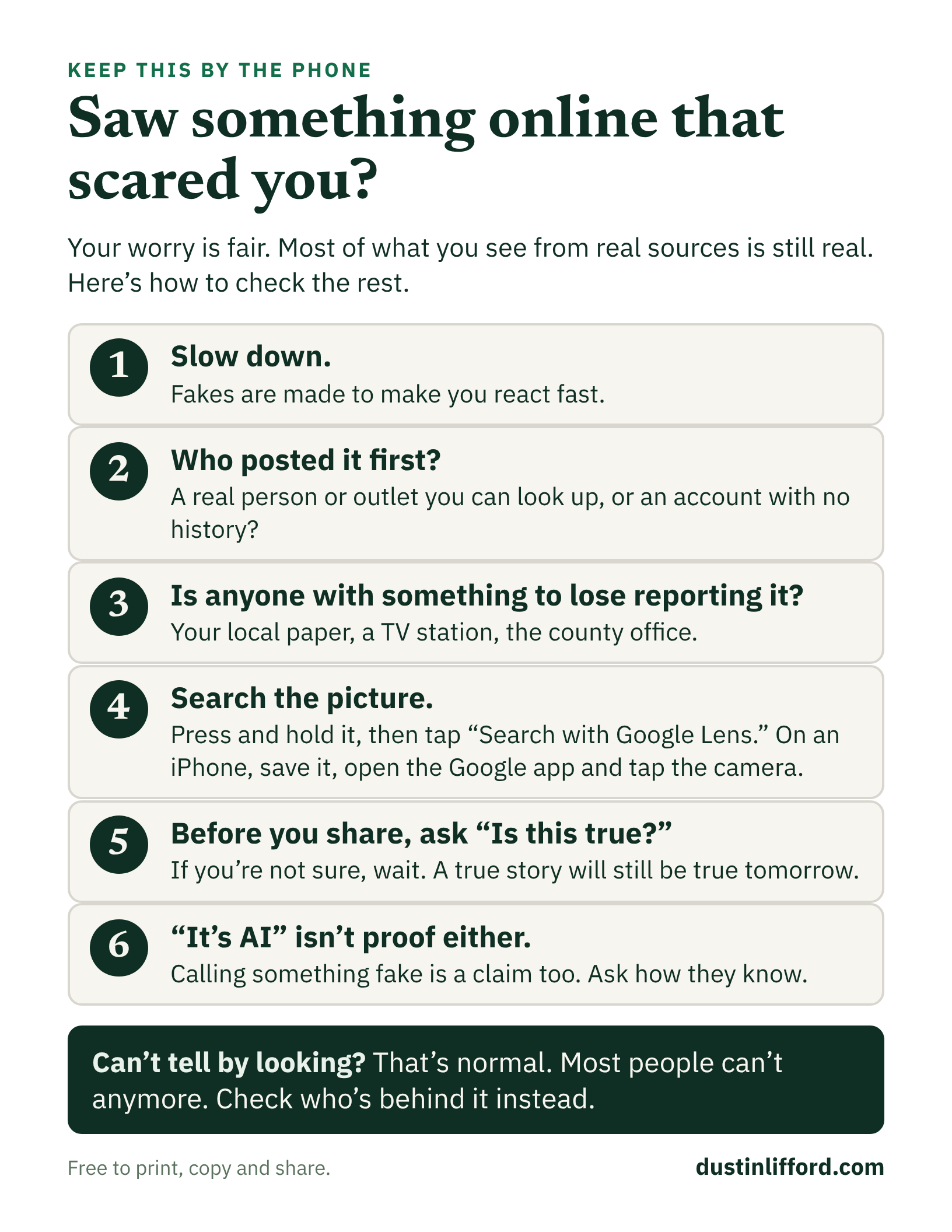
- Slow down. Fakes are built to make you react fast, scared or angry. Taking a minute is most of the defense.
- Who posted it first? Look for a real person or outlet you can look up. An account with no history and a lot of exclamation points is a reason to wait.
- Is anyone with something to lose reporting it? Your local paper, a TV station, the county office or the agency involved. People with their names and reputations on the line still answer the phone.
- Search the picture. On most phones, press and hold the photo and tap "Search with Google Lens" (or "Search image with Google"). On an iPhone in Safari, save the photo first, then open the Google app and tap the camera icon in the search bar. On many newer Android phones, press and hold the bar at the bottom of the screen and circle the picture. You're looking for whether it ran somewhere else first, with a different story attached.
- Before you share, ask "Is this true?" Researchers have found that just asking yourself that question cuts down on passing along false things.
- "It's AI" isn't proof either. Calling something fake is a claim too, and the person making it still has to show how they know.
A search won't catch a fake that was made five minutes ago, and a missing "AI" label on Facebook doesn't mean a picture is real. That's why steps two and three do the heavy lifting. A brand-new fake can fool your eyes, but it can't fake a newspaper that never reported it.
Slow is the protection
This isn't only about news. The FBI's report for 2025 was the first to track complaints that mentioned AI. People 60 and older filed 3,143 of them, reporting more than $352 million in losses. Those numbers cover fake voices and video, not just pictures, and the FBI describes cloned voices of family members claiming to be in trouble. The Federal Trade Commission adds a useful wrinkle. Older adults report losing money to fraud less often than younger people do, but when they do lose money, they lose more. For people 80 and older, the median reported loss was $2,000.
Every one of those scams needs you to hurry. Step one on that list is the one they can't get around.
You can get good at this
Here's the part I'd most like the woman at CVS to hear. This is a skill, and people pick it up fast at any age.
Stanford researchers tested a one-hour online course built for older adults by the Poynter Institute's MediaWise program. It taught the same habits on that list, checking who's behind a claim and searching a picture. Before the course, people averaging 67 years old got 64% of true-and-false headlines right. Afterward they got 85%. A group that skipped the course barely moved. In January, Stanford reported that short YouTube ads teaching the same habits, some only 15 seconds long, got about a quarter of the older adults in their small experiments using those habits on their own.
One hour, and nobody had to learn to spot fake fingers.
Keep it where you'll see it
The research has one more catch. These habits fade within a few weeks if nothing reminds you. So I made a large-print card with the six steps on it. Print it out, stick it on the fridge or by the phone, or hand one to somebody you worry about. It's free, and it doesn't ask for your email.
Download the printable card (PDF)
One of the women in line said you can't believe anything you see anymore. I'd change one word. You can't believe everything you see. Most of it is still real, and the rest you can check.
Sources
- Pew Research Center, "How Americans View AI and Its Impact on People and Society," Sept. 17, 2025. pewresearch.org
- Kellogg Insight, "When Put to the Test, Are We Any Good at Spotting AI Fakes?" May 1, 2025, on Kamali et al., CHI 2025. insight.kellogg.northwestern.edu
- PolitiFact, fabricated photo of Gatlinburg, Oct. 3, 2024. politifact.com
- PolitiFact, Palm Beach County plane crash video, Nov. 2, 2026. politifact.com
- Hoes et al., "Prominent misinformation interventions reduce misperceptions but increase scepticism," Nature Human Behaviour, 2024. nature.com, with the University of Zurich release at news.uzh.ch
- WCYB, "AI tools fuel spread of fake storm images as people seek real-time updates," July 29, 2026. wcyb.com
- Snopes, "CCTV footage shows deadly flood destroying Nepal-China border crossing," Aug. 28, 2026. snopes.com
- Google Search Help, "Search with an image on Google." support.google.com
- Pennycook and Rand, "Accuracy prompts are a replicable and generalizable approach for reducing the spread of misinformation," Nature Communications, 2022. nature.com
- FBI Internet Crime Complaint Center, 2025 Internet Crime Report, April 2026. ic3.gov
- Federal Trade Commission, annual report to Congress on protecting older adults, Oct. 19, 2026. ftc.gov
- Moore and Hancock, Scientific Reports, 2022. doi.org
- Stanford Report, digital literacy interventions and AI, Jan. 8, 2026. news.stanford.edu
- Maertens et al., "Psychological booster shots targeting memory increase long-term resistance against misinformation," Nature Communications, 2025. nature.com