


On May 21, 1996, a state administrative law judge named Ralph B. Christian held a hearing in the auditorium of the Kingsport Public Library on Broad Street. The case was Zeta Image, Inc. against United Telephone-Southeast, which was the local phone company and part of Sprint. The question in front of him, stripped of the tariff numbers, was whether a modem is a telephone switch.
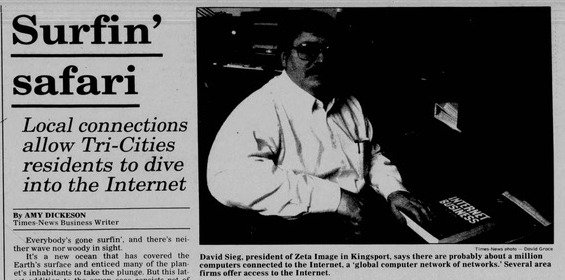
That sounds like the kind of question nobody would drive to the library for. It decided whether anyone in the Tri-Cities could afford to sell internet access. Zeta Image was the company behind The Tri-Cities Connection, TriCon to its customers, one of the first two local internet providers in the region. Its founder, Dave Sieg, had gone to the phone company for lines, read the tariff himself, and decided the phone company was reading it wrong.
"I'm reading the tariff," he remembers telling them. "The tariff says that you will." The phone company's man, as Sieg tells it, said, "Well, it may say that, but I'm not going to sell them to you." So Sieg took it to the state, and the state wrote it down, which is why I can tell you how it ended.
This is the third part of a series on the technology history of the Tri-Cities. The first ranked the oldest domains. The second covered the bulletin boards. This one covers the companies that sold the internet by the hour and then by the month, from the first dial-in numbers in late 1994 to January 2008, when the Greeneville Sun's XTN got out of the business.
The case of the modem
The order that settled it runs six pages, and it's better reading than it has any right to be.

United's business phone service in the area, a Centrex product it called the Advanced Business Connection, came with a rule written in 1989. When those lines were "terminated into customer provided terminal equipment capable of switching and/or extending calls," each line needed an extra charge called a Network Access Register. The rule was written for businesses that hooked phone lines into their own switchboards. It was not written with a rack of modems in mind, because in 1989 almost nobody in Kingsport had one.
In May 1995 TriCon leased space in Johnson City to expand, and, acting through Alan Sieg, Dave's brother, the company started asking United how many of those extra charges a line full of modems would need. The order says the company "was never given a consistent or a definitive answer." On November 22, 1995, the staff of the Tennessee Public Service Commission wrote Dave Sieg a letter saying it regarded modems as equipment capable of extending telephone calls. That same month, United had worked out who was really using the lines, back-billed TriCon, and put the extra charge on every one of them. TriCon was paying about $60 a line.
Sieg's complaint, filed February 19, 1996, said the tariff treated "a computer modem as a telephone switch," and that it treated an internet provider as a reseller of phone service, which it wasn't. Then came the library hearing in May. On June 7 the judge ordered United to take the provision out. On June 30 the Public Service Commission itself ceased to exist, replaced by the new Tennessee Regulatory Authority, which is a level of administrative drama a modem rarely gets to cause.
The new authority heard the case again in August and ruled on August 28, 1996. It found that Zeta Image was both an "enhanced service provider" and an "end user" under federal rules, the same reasoning that kept dial-up affordable across the country, and that United's tariff, as applied to TriCon, was "insufficient, discriminatory, unreasonable, and excessive." United had to rewrite it. The two sides settled in November, and the new Centrex tariff was approved on December 17, 1996.
Thirty years on, Sieg remembers the fight as 100 lines at about $9 apiece. The record is twelve lines in Johnson City at about $60 each, which is a smaller fight with the same shape. He remembers the hearing being in a library, and it was. He remembers winning, and he did. "At one point," he told me, "every dollar that came in, we ended up having to give the phone company to get more phone lines." The order is where you can see why.
Before anyone sold it
The internet was in the Tri-Cities before anyone sold it here. The bulletin board piece has the details. A Unix machine at Med-Systems in Kingsport was trading Usenet news and mail by 1989 and was open to the public by January 1990. The Humanities Forum in Gray was trading newsgroups by March 1989. A 1992 map of those mail connections also lists a VAX in Kingsport called zvax, calling UUNET, a national network provider, as of November 1990. Its contact was Dave Sieg.
How a graphics shop became an ISP
Sieg grew up in Kingsport, graduated from Dobyns-Bennett in 1969, and spent much of the 1980s in Hollywood doing computer animation, including a stint as vice president of R&D at Omnibus Computer Graphics. Omnibus collapsed in 1987 and took the business's three largest computer animation companies down with it. He came home in 1990 and set up ZFx with his father, Larry, and his brother Alan, doing high-end animation for commercials, a good bit of it for clients in Mexico.
The work went to Mexico City on videotape, by FedEx, until Mexico stopped letting videotapes in, for reasons Sieg still describes with some feeling. So ZFx went looking for an internet connection that could carry the tests instead. A 128K line, Sieg says, cost about $1,100 a month. "And it was like, well, how can we sell some of this to other people?"
Other people were already asking. His own history page says people were "coming to our door saying they'd heard we had an Internet connection, and could we 'let them on' through ours." Sieg consulted friends in Atlanta who had started an ISP, run out of a basement with, as he describes it, "a plywood thing full of modems that were all lit up, and a big wire coming into his basement." ZFx licensed software from them and opened The Tri-Cities Connection. Sieg's site says November 1994. His 1996 testimony in the Sprint case, as the state summarized it, says TriCon began operating in January 1995. The domain, tricon.net, was registered December 29, 1994, which splits the difference.
He worried about reaching 250 subscribers, which was break-even. It went faster than that. "I would come to work in the morning," he told me, "and there'd be a little old lady with a Cadillac and the trunk door open full of boxes with brand-new computers, and she was like, 'Put this on the internet.'" ZFx had started in Sieg's basement in Preston Forest and moved into Executive Park, into a building IBM once used. TriCon grew up there.
The best deal he ever made, he says, was building websites for the TV stations, WKPT, WJHL, and WCYB, in exchange for free airtime. The September 1995 Broadcasting & Cable directory shows WKPT and WJHL with pages on tricon.net. WCYB's page that month was on the Business Journal's server, so if TriCon built WCYB's site, it was a later one. The commercials survive on Sieg's YouTube channel. In one, a man at a computer shows a friend the internet. "You must have a huge phone bill," the friend says. "No, it's a local call." In another, "What's this cost?" "The same as a local call." "I gotta have this." In the Tri-Cities of 1995, that was the entire pitch, because almost nothing else was.
Then, one day, the FBI showed up. Nobody at TriCon had done anything wrong. A young customer, Sieg says, had used a TriCon account to get into a computer in California, used that one to get into another, and ended up inside an Air Force computer. The kids were caught. I couldn't find a record of the case, which is not surprising if the people involved were minors, so this one is Sieg's story, and nobody in it is named.
By mid-1997, TriCon was answering on 198 dial-up lines over a full T1 connection to UUNET, at $20 a month for 80 hours and 25 cents an hour after that, with ISDN and dedicated lines for businesses. It had grown to almost 2,000 subscribers. And Sieg had concluded, as his history page puts it, "that the future of ISPs was to become a phone company." He had just spent a year fighting one. "I'm sorry," he wrote, "but I've always hated phone companies."
NetAccess, an Abingdon provider getting into ISDN, wanted to partner. "I said, 'Well, why don't you just buy the company?'" Sieg told me. "Because I'm tired of giving all the money we make to the phone company." In August 1997 NetAccess bought TriCon in a stock swap. Two years later, in August 1999, CFW Communications of Waynesboro, Virginia, bought NetAccess for cash, about $6.0 million up front, according to its annual report to the SEC, picking up 13,500 subscribers in 18 markets and a phone-company subsidiary licensed in Southern Virginia and Tennessee. NetAccess had become, in other words, a phone company. CFW later renamed itself NTELOS. "That was the only time I ever had money for a little while," Sieg says. tricon.net is parked today.
Preferred, from the basement up
The other first provider started in a basement too. The domains piece has the whole story, so here is the short version. Dan Watson ran Preferred Systems, a custom PC builder, out of the basement of his house, with a crew of mostly high school kids. He started a bulletin board, The Preferred Board, so customers could download drivers. At the end of 1994 Chris Heschong, who had just left ETSU, talked Watson into letting him run it, and they added internet access. Preferred's own website later dated its anniversary "officially on November 18th," 1994. It started on four modems.
It grew steadily and without much fuss. Rick Roberts, who replaced Heschong in early 1995 and stayed until 2004, says Preferred had about 100 customers when he started, about 5,000 around 2000, and just under 10,000 when he left. In mid-1997 it had 314 dial-up lines on a T1 from MCI, the most of any local provider, at $19.95 a month. By late 1997 it had a storefront in Blountville on Highway 126, across from Food Country, where you could see a demo of the "Internet Ready Computer System" for its third anniversary: a Pentium 150, a 1.2-gigabyte hard drive, 32 megabytes of memory, a 33.6 modem, Windows 95, and three months of free internet, all for $999.95. Faster 56K lines, the page promised, were coming to the Blountville area first.
Everybody else
TriCon and Preferred had the market to themselves for only a few months. By 1996 the region had a crowd, and by the end of the decade most of it had been bought by somebody else.
| Provider | Based | Online by | What happened |
|---|---|---|---|
| Preferred Internet | Kingsport, then Blountville | Nov 1994 | Bought by East Tennessee Network in 1997 or 1998. The name lasted into 2006. |
| The Tri-Cities Connection (TriCon) | Kingsport | Nov 1994 or Jan 1995 | Sold to NetAccess, August 1997. |
| Expanding Technologies (XTC) | Johnson City | 1995 | Sold to the Greeneville Sun in 1996; folded into XTN. |
| NetAccess | Abingdon, VA | 1995 | Bought TriCon in 1997. Bought by CFW, later NTELOS, in 1999. |
| MountaiNet | Gate City, VA | Jan 1996 | Bought The Wire Company in 2000. Its site is still up. |
| PC Labs | Elizabethton | 1995 | Subscribers went to U.S. Internet of Knoxville. |
| East Tennessee Network (XTN) | Greeneville, with Greene County Online and Washington County Online | 1996 | Left the business in January 2008. |
| 3rd Wave Technologies | Bristol, TN | 1997 | Not Found. |
| The WEB Corp | Johnson City | 1997 | Not Found. |
| Planet Connect | Newport, TN | Oct 1997 | Sold dial-up in Hawkins and Greene counties, among 13 East Tennessee counties it served. Not Found after that. |
| The Wire Company | Johnson City | Sept 1998 | Sold to MountaiNet, November 2000. |
| Global Connection | Kingsport | Dec 1998 | Advertised unlimited access for $18.95. Briefly in the national news in 1999. See below. |
| U.S. Internet | Knoxville | 1994 | Sold dial-up here; took on PC Labs' subscribers. |
The table covers every provider I could document selling dial-up in the Tri-Cities, plus a few from outside it whose local numbers reached in. "Online by" is the earliest record I could find for each one, from a registry, a directory, a newspaper, or the company's own site. Some of them were surely earlier.
Three cents a minute
The shape of that early market came from the phone company, again. Kingsport, Johnson City, and Bristol could not call each other for free. "Anywhere else in the area, it's like any other long-distance call," Heschong told the Kingsport Times-News in February 1995. "There's a 3 cents per minute calling charge. But that still beats calling out of state to somewhere like Colorado." A provider with numbers only in Kingsport was, for anyone in Johnson City, a provider that charged by the minute twice.
That's why Expanding Technologies existed. In the spring of 1995 Heschong and Andy Couch, both from Preferred, started an ISP on Main Street in Johnson City with Dan Watson's blessing, and a domain they picked before they had a company name. Expanding Technologies was worked out afterward to fit it. They meant to be the first provider with a Johnson City number. They were still waiting on phone lines when somebody else got there first. Couch remembers the winner as TriCon or MountaiNet, and Heschong as a company called Global Connection. The state's order in the Sprint case does show TriCon leasing space in Johnson City in May 1995, which doesn't settle it but doesn't hurt TriCon's case.
Heschong's favorite workaround was, briefly, a phone. Sprint was launching cell service, he says, with a deal that let anyone in the Tri-Cities call a Sprint cellphone without a long-distance charge. So Expanding Technologies bought one, forwarded its number to the Johnson City line, and handed the number out to customers all over the Tri-Cities. "Worked like a charm," he wrote, "but Sprint got pretty upset and ended the deal soon after." The bulletin board crowd, as the last piece showed, had been doing the same thing with call forwarding through Colonial Heights and Gray for years. In the Tri-Cities, the cheapest route between two cities was usually a third one.
Expanding Technologies lasted about a year. In September 1995 it listed itself in a national directory of new websites as "Northeast Tennessee's most innovative Internet service provider," and in January 1996 it was testing a "continuous-stream Web-Chat Server" called KangaChat. Meanwhile Gregg Jones of the Greeneville Sun had hired Heschong to start Greene County Online. In 1996 the Sun bought Expanding Technologies, and the pieces became the East Tennessee Network, xtn.net.
How big they got
The best snapshot of the market at its peak is a phone book. Boardwatch Magazine published a directory of internet providers, listing for each one its backbone, its bandwidth, and how many dial-up ports it had, meaning how many callers it could answer at once. The July/August 1997 edition caught the Tri-Cities right before the roll-up.
Preferred had more lines than anyone local, and Preferred and TriCon together had about a quarter of the lines U.S. Internet ran out of Knoxville. Everybody charged about $20. The differences were in the fine print, like TriCon's 80 hours and MountaiNet's 100.
Customer counts are harder to come by, because nobody published them on purpose. The ones on the record are TriCon's almost 2,000, from Sieg; Preferred's under 10,000 by 2004, from Roberts; NetAccess's 13,500 across 18 markets in 1999, from the SEC filing; and XTN's more than 12,000 internet customers in 2003, from the Greeneville Sun. Gregg Jones wrote in Nieman Reports in 2002 that XTN had more than 13,000 subscribers across dial-up, DSL, wireless, and direct connections.
The roll-up
The end of the independents took about three years. TriCon went to NetAccess in August 1997. Sometime between September 1997 and September 1998, East Tennessee Network bought Preferred; Heschong, back as a consultant to XTN, managed the purchase and merger. NetAccess went to CFW in August 1999. PC Labs' subscribers went to U.S. Internet. The Wire Company, which Heschong started in Johnson City in September 1998, went to MountaiNet in November 2000.
The names hung on longer than the companies. In 2001, preferred.com was "Tri Cities Online, A Division of the East Tennessee Network," still in Blountville. In 2003 the Greeneville Sun described XTN as operating Greene County Online and Preferred Internet. As late as December 2006, the Tri Cities Online page still had a link for "Preferred Email." By October 2007 the domain belonged to someone else.
One more from 1999. In March of that year the Melissa virus tore through corporate email around the world, and investigators taking the code apart found a thank-you in it to a site called Codebreakers.org. The Los Angeles Times reported that the site was hosted by "a small Internet service called Global Connection in Kingsport, Tenn." The company's vice president, Dennis Halsey, told the paper he had no idea what was on it. "We hosted the site in total innocence," he said, and Global Connection shut it down. It's the only time I've found a Tri-Cities internet provider in the Los Angeles Times, and I'd have picked a different reason.
The end of the line
XTN outlasted almost all of them by trying to become what Sieg had refused to become. It got state authority to act as a local phone company in November 2001, started selling long distance, and in January 2003 launched local phone service, which the Greeneville Sun called "the first for a local company." It had more than 12,000 internet customers in Northeast Tennessee and Southwest Virginia at the time. In January 2005, as Sprint was changing its Tennessee calling areas, XTN was still keeping local dial-up numbers in twelve counties so its customers wouldn't pay toll charges, which is the same problem TriCon and Preferred were solving in 1995.
In October 2007, XTN announced it was leaving the business. Its chief operating officer, Duane Uhls, put it on Washington. "Now, federal policy reversals have effectively raised operating costs for small CLECs," he told the Greeneville Sun, CLECs being small phone companies that compete with the big one. The company's filing with the state said it served about 1,050 Tennessee customers with local, long distance, and DSL service, and that service would end January 10, 2008. Five days after that, xtn.net was a page that said "This domain is for sale."
XTN's customer service number in those last years was 1-888-323-1142. Preferred's voice line in its January 1995 newspaper ad was 323-1142. The phone number outlived both companies, which, given how much of this story was about the phone company, feels about right.
One question I couldn't settle. A Greeneville Sun profile of Uhls this year says East Tennessee Network was sold to EarthLink in 2007. The paper's own 2007 story about the shutdown doesn't mention a sale, and it counts broadband internet among the services ending for about 1,200 customers. It may be that EarthLink took over some of them, but I don't have a record that says so, and I'd like one.
MountaiNet, in Gate City, is the one still here. Its site still says it has served Virginia and Tennessee since 1995, and it still sells internet access.
Who was first, briefly
I've written around this question in two pieces now, and I'm going to keep it short, because the more of the record I find, the less it matters. Here are the dates. Preferred's own site put its start at November 18, 1994. TriCon's founder says November 1994 on his website and January 1995 in his testimony. Preferred's ad ran January 15, 1995, two days before the Times-News editorial page called it "believed to be the first," and two weeks before it called itself "the first full-service Internet Provider in the Northeast Tennessee area" in a national listing. Chris Heschong, who placed that ad, gives the title to TriCon as the first company built on purpose to bring the internet here. The records give Preferred the earlier documented dates, but none of them shows either company's first paying customer, so they don't settle it. By the people who were there, it was a tie that they're happy to call in each other's favor, which is the most Tri-Cities ending available.
What isn't a tie is the library. One of them went to a hearing about what a modem is, and won, and the phone company had to rewrite its tariff.
Where I come in
I was a DOS kid for most of this, and if memory serves, the first internet number I dialed was Preferred's. I didn't know who Dan Watson was, or that there was a Dave Sieg, or that the lines I was calling had been argued over in the Kingsport Public Library. I thought the internet came from the phone jack.
It came from about a dozen small companies, most of them started in basements by people who wanted it for themselves first, and almost all of them gone within a few years. The people who ran them were generous with their time for this piece, and generous to each other, thirty years later, in a way the market never was. That seems like the right note to end the dial-up years on.
Sources, method, and credit
This piece rests on state and federal records, period directories and newspapers, archived websites, and interviews. Every claim from a person is attributed to that person and labeled as their account. Registry dates are from Verisign, PIR, and ARIN lookups made in September and October 2026. Archived pages were opened in the Internet Archive.
- Tennessee Regulatory Authority, Order, Zeta Image, Inc. v. United Telephone-Southeast, Docket No. 96-00462, October 3, 1996
- Tennessee Regulatory Authority, Order on Zeta's petition, Docket No. 96-00462, December 13, 1996
- United Telephone-Southeast, rebuttal testimony, February 21, 1997 (Centrex tariff approval)
- East Tennessee Network, LLC, notice of discontinuance to the Tennessee Regulatory Authority, October 9, 2007
- CFW Communications Company, Form 10-K for 1999 (NetAccess acquisition)
- Boardwatch Magazine Directory of Internet Service Providers, July/August 1997, pp. 343 and 363
- Broadcasting & Cable, "The Internet TV Directory," September 4, 1995
- Kingsport Times-News, Preferred Board Internet advertisement, January 15, 1995, p. 6D; "Bring government out of the shadows," editorial, January 17, 1995, p. 6A; Amy Dickeson, "Surfin' safari," February 26, 1995, p. 1C
- NCSA What's New, archived copies: January 30, 1995, September 4, 1995, January 1996
- Preferred Internet, third anniversary page, Internet Archive capture, December 21, 1997; preferred.com captures of May 29, 2001 and December 30, 2006
- xtn.net, Internet Archive capture, January 15, 2008
- The Greeneville Sun: "XTN Launches Phone Service, The First For A Local Company," January 1, 2003; "XTN Maintains Local Dial-In Numbers," January 27, 2005; "XTN To Leave Telecom Business By Mid-January Of Next Year," October 6, 2007; "Duane Uhls to retire after 5 decades in the newspaper industry," July 29, 2026
- Los Angeles Times, April 3, 1999 (Melissa virus and Codebreakers.org)
- Gregg K. Jones, "Should Newspapers Offer Internet Access?" Nieman Reports, 2002
- UUCP Mapping Project, Tennessee map file u.usa.tn.1, July 1992
- Dave Sieg, personal history; Dave Sieg, facilities page; TriCon television commercials, uploaded by Dave Sieg
- Christopher Heschong, resume
- PC Labs, About
- Global Connection homepage, Internet Archive capture, December 12, 1998
- Planet Connect, dial-up services page, Internet Archive capture, October 9, 1997; home page, same date
- Dave Sieg, recorded interview with the author, October 22, 2026, and correspondence, September 2026
- Chris Heschong and Andy Couch, emails to the author, September 2026; Rick Roberts, interview with the author, September 2026; Jonathan Harrington, emails to the author, September 2026
Thanks to Dave Sieg, Chris Heschong, Andy Couch, Rick Roberts, and Jonathan Harrington, who were there and keep answering my questions, and to the readers who wrote in after the first two pieces. If you worked at any of these companies, or were a customer who still remembers the dial-in number, I'd like to hear from you.
Not Found, after five research passes and a day of checking every result against its source: the dates cable modems and DSL arrived in Kingsport and Johnson City; the date calls between Kingsport and Johnson City became local; any record of the FBI matter Sieg describes; the date and price of East Tennessee Network's purchase of Preferred; whether XTN's internet customers went to EarthLink; who founded Global Connection, 3rd Wave Technologies, and The WEB Corp; what became of Planet Connect; and a first customer's name or a first bill for any of them.