


Updated October 13, 2026. I ended this piece asking sysops to write in, and they did, along with the people who called their boards. The update settles who ran The Preferred Board, answers what TERC stood for, explains the bad city labels, adds boards the records missed, and takes out one claim I couldn't stand behind. Every change, and who it came from, is listed at the end under What changed in this update.
In May 1983, a Kingsport man named Hal Dougherty wired four IBM floppy drives to an Atari 800, plugged in a 1200 baud modem, and started answering the phone with a computer. He wanted the number to end in 6502, after the Atari's processor, and by his own account it cost him a box of donuts to a lady at the phone company to get it. The board ran for eleven years.
That's the oldest bulletin board system I can find in the Tri-Cities, and it's a recollection, not a record, so treat the date the way you'd treat any story a man tells about 1983. But the records that do exist pick up five years later and run, week by week, to a Friday in May 1998 when the region's network of home computers quietly fell off a list. This is the story of what happened in between, told from two archives few people have reason to open and one man's account of building his own board with the wrong motherboard. Twice.
Before anyone in Kingsport sold internet access, the Tri-Cities was already online. It just wasn't the internet. It was us, calling each other.
What a bulletin board was
A BBS was one computer, in one house, with a modem on a phone line, waiting. You called it with your own modem. If nobody else was on, you got a menu on a text screen: messages, files, sometimes a door into a game. When you hung up, the next person could call. One line meant one caller at a time, which is why the busy signal is the sound most people associate with the era, and why the sysop's mother associated it with never being able to use the phone.
The person running it was the sysop, and the machine was usually in their bedroom or a spare room, running all night on hardware they'd bought with their own money. Some boards joined FidoNet, a volunteer network that moved mail between boards by having them call each other in the middle of the night, when long distance was cheap, and pass messages along in bundles. A message posted in Kingsport could turn up in a board in Australia a few days later. No company owned it. No one got paid.
The internet arrived here in late 1994, and within four years the region's network of boards had dropped off the list, though a few stubborn individuals kept answering the phone into the 2000s. That much, roughly, everybody who was there remembers. What I couldn't find written down anywhere was who ran them, when, and in what order.
Where the records are
Two sources make this piece possible, and neither is a newspaper.
The first is the textfiles.com BBS list, a project by the archivist Jason Scott that collected old phone-number lists from the era and sorted them by area code. The 615 and 423 files together hold around 1,500 numbers, of which about sixty belong to Tri-Cities telephone exchanges, with sysop names and the years each number appeared in a list. It's a compilation, not a census. Boards that never made it onto a list aren't in it, and the city labels are unreliable, for a reason I'll come back to.
The second is better. Every Friday from 1986 on, FidoNet published a nodelist, a text file naming every board in the network worldwide, with its sysop, city, phone number, modem speed, and the net it belonged to. A substantial archive of the weekly lists survives, and both a searchable index and the raw files are public. That means any board that joined FidoNet can be placed to the week it appeared and the week it left. For a decade of local history that otherwise exists only in memory, that's as good as a record gets.
I pulled every weekly list from 1988 through 1998, filtered for Tri-Cities exchanges, and counted. The chart below is the result, and I'd like to note that for most of its length it goes up.
The network, in order
The first Tri-Cities board in the nodelist is The Circuit Board in Bristol, sysop David Jones, on September 9, 1988. The 1988 archive is thin, so he may have been there earlier. By January 1990 he had company. The Humanities Forum in Gray and GOOD News in Bristol were listed, and by that March a board listed as ETSU Family Medicine in Johnson City, under a Gary Smith who that fall also listed one called The Dobyns-Bennett Tee-Pee. The nodelist records names, not who signed off on them, so whether the university and the high school knew they had bulletin boards is a question for Mr. Smith. Either way, boards bearing a medical department's name and a high school's name were in FidoNet before Eastman had a domain name.
Those early boards were members of nets hosted in Nashville, which meant their mail went through Middle Tennessee. On July 6, 1990, the region got its own. Net 3622, "Bristol Tenn Area," was hosted by Mike Hill of GOOD News, with the Byte Board, the Black Lagoon, the Commo Bunker, and ETSU Family Medicine as founding members. Being the host meant your machine was the one every other board called each night, and that you answered for the net to the region above you. It was a volunteer job with the hours of a paper route.
Kingsport split off on January 31, 1992. Net 3642, "Upper East Tennessee Net," was hosted by Joe Byrd of The Commo Bunker, with The Poor Boy's BBS in Gray, Doc's Place in Gray, and The Night Owl in Johnson City as its first members. That November the Bristol boards moved into it under their own hub, Bristol's net was retired, and its number was handed to a net in Winchester, Tennessee three months later. In January 1993 the whole thing was renamed the Southern Appalachian Net, which is the name it kept.
The hosting moved around. Byrd, then Wayne Serena of Wayne's World, then Larry Hayes in Bristol for two years, then Serena again, then Marie Herring, and from February 1996 Stephen Cummings of The Night Owl in Johnson City, who ran it to the end. In the series I compiled, the region peaked at 24 boards in the nodelist in June 1994. On May 1, 1998, the net's section carried fourteen entries representing ten named systems. On May 8, the entire section was gone, and with it the region's only piece of the pre-internet internet.
Southern Cross BBS in Kingsport, Bob Burns, remained in FidoNet under a separate regional address until April 2004. The textfiles list also has Kingsport's Red Tower from 1999 to 2004. Neither listing alone establishes an exact shutdown date or that the phone line was still answering, but if they were, somebody in Kingsport was still running a dial-up bulletin board when Facebook launched, which I choose to read as a statement of principle.
Bradley Noe, who ran The Red Tower, wrote in after this ran. He ran a Wildcat board mostly in high school and let it go when the internet took his attention. He also knew Bob Burns. Burns came to his house to help him set up the system and get FidoNet working, which is the whole network in one sentence. One sysop drove to another sysop's house so a teenager could get mail. Noe says Burns died in 2023. He still has one of the machines that ran The Red Tower, and doesn't know if it boots.
The boards
Here are some of the boards the records document, with the years they appear. Sysop names are as printed in the public lists.
| Board | Where | Years | Sysop | Note |
|---|---|---|---|---|
| E.T.A.C.E. | Kingsport | 1983 to 1994 | Hal Dougherty | Atari 800. Recalled by its sysop; not in the nodelist. |
| Level One | Gray, then Johnson City | About 1984 to 1996 | Ed Jones | Commodore 64 running from a RAM pack he soldered himself. Recalled by its sysop; not in any list. |
| The Circuit Board | Bristol | 1988 to 1993 | David Jones | First Tri-Cities board in the nodelist. |
| GOOD News | Bristol | 1990 to 1991 | Mike Hill | Host of the first Tri-Cities net. |
| The Byte Board | Bristol | 1990 to 1995 | Larry Hayes | Hosted the net from Bristol, 1993 to 1995. |
| The Commo Bunker | Kingsport | 1990 to 1994 | Joe Byrd | Founding host of the Kingsport net. Left the week of Nov 18, 1994. |
| ETSU Family Medicine | Johnson City | 1990 to 1991 | Gary Smith | Listed under a university department's name. |
| Dobyns-Bennett Tee-Pee | Kingsport | 1990 to 1991 | Gary Smith | Listed under the high school's name. |
| TERC #1 and #2 | Kingsport | 1989 to 1992 | Frank Myers | Tennessee Eastman Recreation Center, per readers. Listed as Brentwood. |
| The Night Owl | Johnson City | 1991 to 1998 | Stephen Cummings | Hosted the net for its last two years. |
| The Poor Boy's BBS | Gray, then Kingsport | 1991 to 1997 | Ron Herring | PCBoard software. |
| Wayne's World | Kingsport | 1992 to 1995 | Wayne Serena | Hosted the net twice, which nobody does by accident. |
| Southern Cross | Kingsport | 1992 to 2004 | Bob Burns | Longest run in the records. Wildcat software. |
| Think & Reply | Bristol | 1992 to 1998 | Phil Morrison | |
| Fast Bytes | Kingsport | About 1992 to 1993 | Rick Roberts and his brother | Friends and family only, by Roberts' account. |
| The Rx BBS | Johnson City | 1993 to 1996 | Alan Hughes | QuickBBS. |
| Starship Allandale | Kingsport | 1993 | Mike Crumley | WWIV. Listed as Nashville. Sysop named by readers. |
| Asgard | Bristol | 1993 to 1998 | Eddie Nelson | |
| Short Circuit | Blountville | 1994 | Brian McCrary | Internet email on a BBS. See below. |
| The Preferred Board | Blountville | Jan to Nov 1994 | Dan Watson | Spelled "Preffered" in the lists. Became Preferred Internet. See below. |
| The Virtual Screwdriver | Johnson City | 1993 to 1994 | CtG / Christopher Heschong | The lists say 1989; its sysop says 1993 or 1994. In FidoNet Sept 1993 to June 1994. See below. |
| The Inferno | Kingsport | 1992 to at least 1995 | Orpheus and Slick | Not in any list. See below. |
| Private Connection | Mosheim | 1995 to 1998 | Ronnie Gosnell | Three lines; Greene County's hub. |
| TekNiq | Bulls Gap | 1995 to 1999 | Kelly Walker | TriBBS. |
| The Red Tower | Kingsport | 1999 to 2004 | Bradley Noe | Wildcat. Last board on the lists. |
That's a partial list, and since this piece first ran, a longer one. The full table, with about sixty boards from the lists and every weekly nodelist entry for the region, is in a spreadsheet I'll share with anyone who asks, and I'd like to hear from anyone who ran a board that isn't on it.
The Inferno
The records have a hole in them, and I know its shape because someone who was in it wrote to me.
After the last piece ran, Jonathan Harrington, who built some of the region's earliest websites, mentioned he'd run a BBS before any of that, "probably 1992 or so." Then he found the write-up he'd done about it years ago, and an ANSI logo, and a Polaroid. The board was The Inferno, Kingsport, 245-8990, started in early 1992 by two co-sysops. Jonathan was Slick. His friend went by Orpheus and later Critical Mass, and is the other man in the photograph. Their goal, as Jonathan put it, was to make a great BBS by the simple method of staying in business longer than the two or three weeks most local boards lasted.
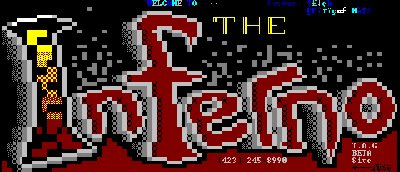
His account of building the machine in early 1993 is the best thing I've read about the era, because it's about hardware. A 486SX/33 motherboard, a mini-tower, two CD-ROM drives, a 340-megabyte Western Digital Caviar. Neither of them had assembled a computer before. The Intel board didn't come in, so the shop sold them one with a Cyrix chip, which rebooted itself during the first format. They drove across town for another. It rebooted too. They spent thirty minutes on hold with the manufacturer to learn that two hard drives need their master and slave jumpers set, a lesson every one of us learned exactly once and never forgot. The board kept rebooting through a whole weekend of live service before the shop finally swapped in an Intel board with a slower processor, at which point it ran for years. Anyone who built PCs in the 90s just nodded.
In January 1994 the board moved houses to take the cost off one sysop, who was in school full time, and every regular user updated their dialing directory within a month. In late 1995 the Caviar started throwing write errors, an 850-megabyte Maxtor went in, and the sysops spent a stretch of nights with a friend called The Joker trying to get BinkleyTerm to pass a FidoNet mail packet between two machines, "since neither one of us actually knew what we were doing." It worked. The Inferno passed its first packet in late 1995. By then, in Jonathan's recollection, the coordinators who would have relayed it were mostly gone, so they'd built a mailbox with nobody to write to. That's the era in one sentence. There is an eight-hour documentary about the BBS era on DVD. The Inferno, Jonathan notes, did not make the cut.
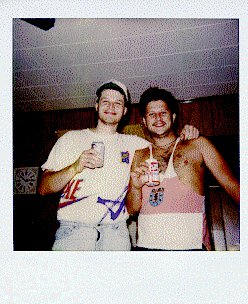
Jonathan also remembers Dobyns-Bennett having a board, which the nodelist confirms, and Eastman running one, which the nodelist doesn't show. The textfiles lists do show two boards on Eastman's 229 exchange from 1989 into the early 1990s under the name TERC, and when this first ran I asked what that stood for. Readers answered. Jeff Bowman, who downloaded files from it, says his brother remembers TERC as the Tennessee Eastman Recreation Center, and Jonathan recalls it being kept by an Eastman employee in Building B-310. So Eastman did have a bulletin board, or at least its recreation center did, which in a company town is the same thing with a softball schedule. He remembers other local boards that never made any list, and he's still in touch with their sysops.
Jeff also says The Inferno was his favorite board, the one where he and his high school friends played Legend of the Red Dragon, and he remembers a Kingsport board called Lucifer's Gate, run by a high school acquaintance, that appears in no list I can find. Andy Couch, who worked at Preferred, names The Inferno and a board called Aneurism as the two he spent the most time on. Aneurism isn't in my records either.
Here's the hole. The Inferno does not appear in the textfiles list or in any weekly nodelist. A board that ran for at least three years in Kingsport, with a logo and a following and a modem upgrade, is invisible to both records I used, because it never got onto a published list and never had a coordinator passing it mail. If you counted the region's boards from the records alone, you'd miss it, and you'd miss every board like it. The chart above is a floor, not a count. Every sysop who reads this and doesn't see their board on it is a correction I'd like to make.
One of those corrections came from Johnson City, which until then had been the quietest city in this story. Ed Jones ran Level One, first in Gray and then in Johnson City, by his memory from about 1984 to 1996. It ran on a Commodore 64 with two 3.5-inch and two 5.25-inch drives and a 512K RAM pack he soldered extra memory into, so the whole system ran from RAM. His BBS software, a modified version of Color 64, could exchange messages with another board, and most of the people calling it were on IBM PCs, which is a Commodore owner's idea of a good joke. If the 1984 date holds, Level One is the second-oldest board anyone has claimed in the region, a year behind E.T.A.C.E. It is in neither record I used.
The exchange test
One technical note, because it's the mistake that would have wrecked this piece and it's the same mistake that keeps wrecking automated research.
The textfiles list labels the Blountville board The Preferred Board as "Portland, TN." It labels Hal Dougherty's E.T.A.C.E. as "Mount Juliet." It labels two boards on the 229 exchange as "Brentwood." All three are Nashville suburbs, and all three conflict with the contemporary records. Before the 1995 split, Middle and East Tennessee shared 615, and somewhere along the way these numbers got a city attached to them that the sysops themselves never used. When this first ran, I said I didn't know how that happened.
A Kingsport BBS user from the era, who asked not to be named, wrote in with the answer. Until 1995, exchanges like 229, 245, 246, 247, and 378 were Kingsport numbers in area code 615. When the Tri-Cities moved to 423, those exchanges were free to be handed out again in 615, which by then meant Middle Tennessee. Anyone who later matched an old 615 number to a city got the post-1995 answer. The lists bear him out. Starship Allandale, a board he and Jeff Bowman both place in the Allandale area of Kingsport and that he says was run by Mike Crumley, sits on the 378 exchange and is labeled Nashville. So is The Dobyns-Bennett Tee-Pee, which is hard to run from Nashville.
The fix is to read the exchange yourself. 323 is Blountville. 288 is Kingsport. 229 is Eastman's exchange in Kingsport. And the nodelist settles it, because the nodelist has a city field the sysop filled in: "The_Preffered_Board, Blountville_TN." I mention this because I ran the same list through an AI research tool early on, and it accepted the bad labels, invented a few of its own, and then added four Tri-Cities boards whose names it had found on a list of fake BBS names somebody generated with a neural network as a joke. It cited the joke. The dates in this piece come from the weekly lists, read by me, and the exchanges were checked by hand, which is slower and has the advantage of being true.
The long-distance problem
The same reader explained something else the lists can't, which is why the map of local boards looks the way it does. Calling between Kingsport and Johnson City cost money by the minute. But Kingsport exchanges could call 239, Colonial Heights, for free. Johnson City could call 477, Gray, for free. And 239 and 477 could call each other for free.
So, he says, a few sysops set up boards in those two exchanges that would call-forward for you. You logged into the Colonial Heights board, typed in the number you wanted to reach, and logged off. The board dialed *72 and forwarded its line. You called back and went through. Chain the Colonial Heights board to the one in Gray and you could reach a Johnson City number from Kingsport without paying for it, provided you moved faster than either board timed out. He remembers the Colonial Heights sysop as Sam and the Gray sysop, maybe, as Andy, and not the names of either board. That isn't a bulletin board feature anyone advertised, and it's the most Tri-Cities thing in this piece.
He also remembers a company selling long-distance service opening a board with something like four lines in Kingsport and four in Johnson City, so people in both cities could chat with each other live, which nobody here had seen before. It ran a multi-user text game called Quest of the Alchemist, and "much time was spent slaying dragons." He doesn't remember the company's name and doubts it was Preferred. If you do, I'd like to hear it.
The internet came from inside
The usual story is that the internet showed up and killed the boards. The records tell it a little differently. The boards brought the internet here first.
In 1993, according to his biography in a 2006 telephone-company filing with the Tennessee Regulatory Authority, a Blountville sysop named Brian McCrary added internet email to a public BBS, making it "the first to provide such access in the Tri-Cities area." The filing doesn't name the board. A separate record does the identifying: the May 1994 nodelist lists McCrary's Short Circuit BBS in Blountville with a UUCP flag, the marker for an internet mail link. The two records were made twelve years apart by different people for different reasons, which is about the best corroboration this era offers. Chris Heschong, whose board comes up below, read that and wrote in. "All these years, I always thought my board was the first to offer Internet e-mail in the Tri-Cities," he said, "but yeah based on your research, Short Circuit must have beaten me to it!" His board's mail went out by UUCP to Colorado SuperNet, which sent him a welcome letter for the account on January 12, 1994. Every night the Virtual Screwdriver called Colorado long distance to trade email and Usenet posts. If you had an email address in the Tri-Cities in 1993 or 1994, it very likely ended in the name of a bulletin board.
There may be an older one. The reader who asked not to be named says that in the late 1980s a Kingsport medical-office software company, Med-Systems, ran a Unix BBS, and that its sysop jumped into chat one night and gave him a shell account and an email address there, with mail routed through UUCP. He pointed me to Usenet posts from as early as June 1989 signed with a Med-Systems address in Kingsport. Google Groups won't open them for me, from any network I've tried, so I'm reporting this as his account, not as a record. If the posts hold up, internet-connected mail reached Kingsport four years before Short Circuit, on a company's machine rather than a hobbyist's. "My first email address didn't have an @ symbol," he says, which anyone who used a UUCP bang path will understand and everyone else will have to take on faith.
The first version of this piece also said a Kingsport board called Fast Bytes was on a March 1994 national list of internet-email boards. That came from one of the research tools, and I never opened the list myself. Rick Roberts, who later worked at Preferred Internet, says he and his brother started Fast Bytes around 1992 or 1993 and never took it public. It was friends and family only. I've taken the claim out.
Then there's the board that became an ISP. On January 28, 1994, a sysop named Dan Watson in Blountville joined the net with The Preferred Board, spelled "Preffered" in the list. On November 18, 1994, it was removed. Preferred Internet registered preferred.com on October 31, 1994, and its first employee dates his hiring to November. When this piece first ran, I called that a very strong coincidence with a date on it, because no record said the sysop and the ISP's owner were the same man.
It wasn't a coincidence. Three people who worked there, Andy Couch, Chris Heschong, and Rick Roberts, each name Dan Watson as Preferred's owner. Couch, who started at Preferred Systems in the spring of 1994, says it was Watson's custom PC business, run out of the basement of his house on Cochise Trail and staffed mostly by high school kids, and that Watson started The Preferred Board in early 1994 so customers could download drivers. "I don't think it ever really had the community of a BBS," Couch wrote. He also says the board's name was spelled correctly and the extra F belongs to whoever typed the listing. Heschong says Watson "wasn't sure what to do with it," so at the end of 1994 Heschong talked him into hiring him to run it, and they added internet access right away. Callers dialed the board and dropped out of it into a Linux shell connected to the internet. On January 15, 1995, an ad in the Kingsport Times-News sold "The Preferred Board INTERNET," and the data number in that ad, 323-2974, is the same number the FidoNet nodelist carried for The Preferred Board. The bulletin board didn't just turn into the ISP. For a while it was the ISP, on the same phone line.
That first employee is the other thread. The textfiles list has a Johnson City board called The Virtual Screwdriver from 1989 under the handle CtG; the nodelist has the same board from September 1993 to June 1994 under the name Christopher Heschong. Heschong says the 1989 date is wrong. He started the board in 1993 or 1994, after serving as co-sysop on another local board, maybe The Night Owl. A few months after it left the net, he went to work running Preferred's board, then co-founded Expanding Technologies in Johnson City with Andy Couch, then helped the Greeneville Sun start its ISP, then worked at XTN, and in 1997 and 1998, by his own resume, managed Preferred Internet's purchase and merger. A sysop went to work for a bulletin board that was becoming an ISP, and later helped close the deal that ended it. If you wanted the whole story of this region's transition in one person, he's the person. I said I'd like to buy him a coffee. He wrote in instead, which was cheaper for me, and much of what he said is now in the domains piece.
The week of November 18, 1994 is visible in the chart. Seven boards left the list in one week: The Preferred Board, The Ice Palace, Shorty's Corner, Sation 1, NO CARRIER ][, micro*LINE, and The Commo Bunker, the board that had founded the Kingsport net two years earlier. It is the largest weekly drop in the series I compiled, and it happened the month Preferred Internet opened. I can't prove the one caused the other. I can say the timing is not subtle.
A registry date is still not a launch date
Readers of the last piece will recognize the rule, and it holds here in a different form. The nodelist tells you when a board joined FidoNet, not when it went online. E.T.A.C.E. never appears at all, and neither does Level One. The lists can be wrong in the other direction, too. The textfiles list put The Virtual Screwdriver four years before its sysop says it existed. The textfiles year ranges say when a number made it onto somebody's list, not when the sysop plugged in. Jonathan's Inferno, with a documented 1992 start, a 1993 rebuild, and a 1995 mail packet, is in neither. The records are precise about what they measure and silent about everything else, and the honest version of a piece like this says which is which.
And the 423 on The Inferno's logo screen tells you it was drawn no earlier than 1995, because that's when the area code was assigned, with both codes working until February 1996 and plenty of people never updating anything. Same trick as the last piece, with the same limits. A 423 on a Tri-Cities artifact puts it at 1995 or later. A 615 on one suggests earlier, unless the owner just never got around to it, which, this being the Tri-Cities, is a live possibility. It's a cheap way to date a thing nobody wrote a date on, as long as you say "probably."
Where I come in
I don't have a BBS story. I was a DOS kid on a hand-me-down 286 and then a 386, and by the time I had a modem the boards were emptying out and the first number I dialed belonged to an ISP, if memory serves Preferred's. The people in this piece were five to ten years ahead of me and did it on their own phone lines, in their own bedrooms, with their own money, and most of them never got so much as a newspaper mention for it. The Kingsport Times News and the Johnson City Press surely covered some of this. I couldn't find it, and neither could four research tools, because the archives are behind paywalls and the indexes don't go that deep. Somewhere there is a 1993 feature with a photo of a teenager and a modem, and I would like it.
So, as far as I can find, this is the first time most of these names have been written down together. Joe Byrd, Mike Hill, Larry Hayes, Wayne Serena, Marie Herring, Stephen Cummings, David Jones, Bob Burns, Gary Smith, and the rest ran the Tri-Cities' first network, for free, for a decade, on hardware that rebooted when it felt like it. If you knew them, or were them, I'd like to hear about it.
What changed in this update
This piece first ran in September 2026. The October 13 update is based on emails, an interview, and comments from people who ran or called these boards, plus a second pass through the lists. Here is everything that changed and who it came from.
- The Preferred Board's owner is confirmed. Andy Couch, Chris Heschong, and Rick Roberts each name Dan Watson as Preferred's owner, and the January 15, 1995 Preferred ad carries the board's FidoNet data number. The "strong coincidence" language is gone.
- Spelling corrected to The Preferred Board. Couch says the board was spelled correctly; the 1995 ad agrees. "Preffered" is how the lists printed it.
- The Virtual Screwdriver's start date. Heschong says he started it in 1993 or 1994, not 1989 as the textfiles list says. The table, the Heschong paragraph, and the dating section now reflect that, and the claim that he joined "the region's first ISP" is gone, since who was first is still open.
- TERC answered. Tennessee Eastman Recreation Center, per Jeff Bowman's brother, with Jonathan Harrington placing it in Building B-310.
- The city-label errors explained. A Kingsport BBS user from the era, who asked not to be named, says Kingsport exchanges were reassigned to Middle Tennessee after the 1995 split.
- Boards added. Level One (Ed Jones), Starship Allandale, TERC, and Fast Bytes are in the table, and Lucifer's Gate (Jeff Bowman) and Aneurism (Andy Couch) are in the text.
- New section on the long-distance problem, from the same anonymous reader.
- Removed the Fast Bytes claim. I had it on a March 1994 national internet-email list based on a research tool I never checked. Rick Roberts, who ran it, says it was never public.
- Added the Med-Systems lead as an unverified account, and Heschong's note that Short Circuit beat his board to internet email.
- Added Bradley Noe's account of The Red Tower and of Bob Burns.
Thanks to everyone who wrote in. The piece is better for every one of you, and the offer stands. If you ran a board that isn't here, I'd still like to hear about it.
Sources, method, and credit
FidoNet nodelists: the complete weekly archive at nodelist.fidonet.cc, 1988 through 1998, downloaded and filtered for Tri-Cities exchanges on September 11, 2026, and the searchable NodeHist index by Pavel Gulchouck. BBS lists: the textfiles.com area-code lists for 615 and 423, compiled by Jason Scott, including the sysop comment by Hal Dougherty on the 615 old-school list. Brian McCrary's biography: Telescan, Inc., application to the Tennessee Regulatory Authority, docket 06-00151, May 22, 2006, Exhibit E. Christopher Heschong's resume. Kingsport Times-News, Preferred Board Internet advertisement, January 15, 1995, p. 6D, supplied by Chris Heschong. Colorado SuperNet welcome letter, January 12, 1994, courtesy of Chris Heschong. The 423 area code: in service September 11, 1995, with a permissive dialing period to February 26, 1996 (RSIC newsletter, October 1995). Board dates in this piece were checked by board name across the weekly lists, not by FidoNet address, because addresses were reused; an early draft got three boards wrong that way, and a careful reader caught it.
The Inferno account, logo, and photograph are Jonathan Harrington's, shared with permission. His original write-up is a 1996 file he asked me to clean up rather than quote, so the Inferno section is my paraphrase of it, checked with him. This piece would not exist in this form without him. Sysop names appear as printed in the public lists of the time; I did not look up anyone's current whereabouts, and won't.
Firsthand accounts added in the October update came from Chris Heschong and Andy Couch (emails, September 2026), Rick Roberts (interview, September 2026), Ed Jones, Jeff Bowman, and Bradley Noe (comments on this piece, September 2026), Jonathan Harrington, and a Kingsport BBS user from the era who asked not to be named. Their accounts are recollections and are labeled that way in the text.
Not Found, after four research passes and two days in the raw lists: any Kingsport Times News, Johnson City Press, or Bristol Herald Courier article on a local bulletin board between 1985 and 1998; a period membership list for the Southern Appalachian Net beyond the nodelist itself; a document naming Preferred Internet's owner, as opposed to the three people who worked there and name him; the 1989 Med-Systems Usenet posts, which Google Groups would not open; the names of the call-forwarding boards in Colonial Heights and Gray; and the actual shutdown date of any board, as opposed to the week it left a list.